
Working at Height: Europe’s Persistent Safety Challenge
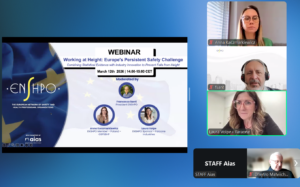
On 12 March 2026, ENSHPO, in collaboration with AIAS, launched its 2026 webinar series with a focused session on one of the most pressing occupational safety issues in Europe: working at height.
The webinar brought together OSH professionals, safety leaders, and industry representatives from across Europe to examine why falls from height continue to result in serious and fatal injuries—despite decades of regulation, training, and technological advancement.
Speakers and Contributions
The session was moderated by Francesco Santi, President of ENSHPO, who opened the discussion by setting the broader European context and outlining the objectives of the 2026 webinar series.
Two expert speakers contributed in-depth perspectives:
Anna Kaczmarkiewicz, representing OSPSBHP in Poland, delivered a practice-oriented presentation grounded in real accident analysis and behavioral safety insights.
Laura Volpe, CEO of Faraone Academy and Board Member at AIAS, provided the industry perspective, focusing on innovation, equipment standards, and the evolution of safety solutions.
Together, their contributions created a comprehensive view that combined statistical evidence, real-world experience, and technological innovation.
Understanding the Scale of the Problem
In his opening remarks, Francesco Santi highlighted the persistent nature of fall-related incidents across Europe. Drawing on European data, he emphasized that falls from height remain among the leading causes of workplace fatalities, particularly in high-risk sectors such as construction.
However, the issue is not confined to one industry. Slips, trips, and falls occur across a wide range of workplaces, from warehouses to manufacturing environments. What makes the situation particularly concerning is the lack of significant progress in reducing these incidents over time.
This stagnation suggests that while regulations and technologies are in place, they are not being translated effectively into everyday practice.
Bridging the Gap Between Knowledge and Action
A central theme of the webinar emerged during Anna Kaczmarkiewicz’s presentation: the disconnect between what workers know and what they actually do.
Through the analysis of real incidents, she demonstrated that unsafe behavior is a major contributing factor to fatal accidents. Workers often understand the risks and procedures but fail to apply them consistently. This gap is frequently influenced by time pressure, routine, and overconfidence.
Her examples illustrated how even minor lapses—such as not fastening protective equipment or underestimating a short task—can have fatal consequences. Notably, she stressed that falls from relatively low heights can be just as dangerous as those from higher elevations, challenging common assumptions about risk.
The Role of Leadership and Safety Culture
Another key insight from Anna’s presentation was the critical role of leadership. Supervisors and managers are not only responsible for enforcing rules but also for shaping behavior on-site.
When unsafe practices are ignored, they quickly become normalized. Conversely, active supervision, open communication, and visible commitment to safety can significantly reduce risk.
She emphasized that effective safety culture goes beyond documentation. Risk assessments, procedures, and equipment must be actively understood, discussed, and applied by teams in real working conditions. Without this, even the best-designed safety systems remain ineffective.
Innovation, Standards, and Practical Solutions
Laura Volpe’s presentation shifted the focus to technical solutions and regulatory frameworks, offering insight into how industry is addressing the challenges of working at height.
She outlined the evolution of equipment—from basic ladders to advanced platforms and mobile systems—highlighting how design improvements aim to reduce risk and improve usability. European standards play a crucial role in ensuring consistency and safety across equipment types, from ladders and scaffolding to mobile elevating work platforms.
However, a recurring theme was that equipment alone cannot guarantee safety. Incorrect use, poor selection, or lack of training can negate even the most advanced safety features. For example, using a ladder designed for inspection tasks instead of one intended for prolonged work can significantly increase risk.
Laura also emphasized the importance of training initiatives, such as those delivered through industry academies, which focus not only on technical knowledge but also on behavioral awareness and best practices.
Key Discussion Points from the Q&A
The interactive discussion reinforced several important ideas. One of the most notable was the limitation of regulatory definitions. While many frameworks define “working at height” as tasks above two meters, real-world evidence shows that fatal accidents frequently occur below this threshold.
Participants also explored why workers continue to take unnecessary risks. The discussion highlighted factors such as ingrained habits, lack of supervision, and a tendency to prioritize speed over safety. In many cases, workers rely on past experience and assume that accidents are unlikely to happen to them.
Another critical point was the need to shift from reactive to proactive safety management. Too often, organizations focus on corrective measures after an incident occurs, rather than investing in prevention through continuous risk assessment and engagement.
Key Takeaways
-
Falls from height remain a leading cause of fatal workplace accidents in Europe
-
The challenge is not only technical—human behavior plays a decisive role
-
There is a persistent gap between knowledge and action on the ground
-
Leadership and supervision are essential to preventing unsafe practices
-
Risk assessment must be practical, collaborative, and continuously applied
-
Even low-height falls can have fatal consequences
-
Equipment alone is not sufficient—correct use and training are critical
-
Building a strong safety culture is key to achieving lasting improvement
The overall conclusion is clear:
Reducing falls from height requires an integrated approach that combines data, behavior, leadership, and innovation.
Join the Next Webinar
The ENSHPO 2026 webinar series continues with the next session:
📅 14 May 2026 | 14:00–15:00 CET
🎯 AI and Innovation in OSH: A European Perspective
This session will explore how artificial intelligence is shaping occupational safety and health, including practical tools, emerging risks, and its impact on workplace wellbeing.
🔗 Register here:
https://forms.gle/gW4efUKM6HfgzhLw9
Thank you to all speakers, organisers, and participants for contributing to an insightful and engaging session.


